
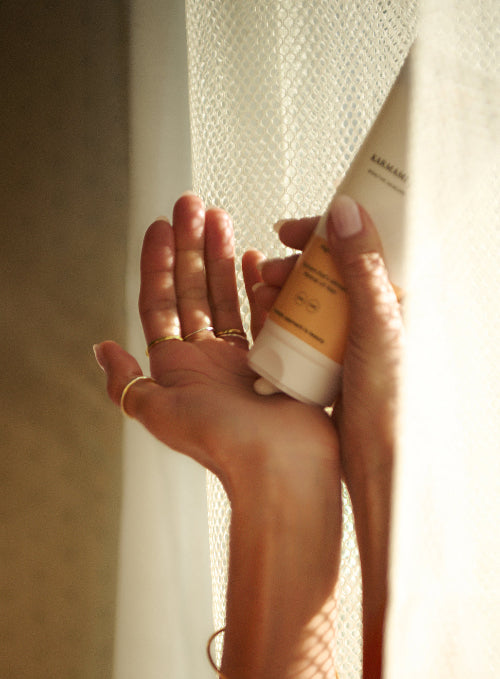


“A while back I was sent an article, based on scientific studies, that flipped my world of skincare upside down. Recent scientific studies have discovered why healthy skin is an essential part of longevity.”
By founder, Mette Skjærbæk
When we ask, “What suncare do you wear?”, we’re not looking for the perfect answer – but for awareness. With the recent relaunch of Karmameju Sun, founder Mette Skjærbæk shares why choosing the right sunscreen is an important decision – for both our skin and overall health.
You’ll also learn about the differences between sunscreen filters, and why Mette chooses to use only mineral sun filters – for herself, for her daughters, and for everyone who uses Karmameju.
__________________________________
My reasons for choosing only mineral sunscreens are many.
- They work immediately after application.
- They do not sting the eyes.
- They are recommended for children.
- They are recommended for conditions such as sun allergy and rosacea.
- They occur naturally in the earth.
- They provide instant broad-spectrum protection.
- They do not leave permanent yellow stains on clothing.
- And they do not clog pores.
There are three types of sunscreens: mineral, chemical and nano-based sunscreens. To me, mineral sunscreen is the only safe choice and it has been since I was in my 20s and became familiar with how skincare ingredients can affect our vital body systems and health.
My decision not to use chemical and nano sunscreens is based on a precautionary principle. In my opinion, there is too much scientific evidence that points in a negative direction about chemical filters, and the promise I have made to consumers is based on transparency and caution.
Developing Karmameju SUN has not been easy. With the first version of our mineral sunscreen, I think we got 90% of the way to making it invisible on the skin and easy to apply. In the new version, I think we've achieved that.
The ‘easy’ solution would have been to use chemical sunscreens or mineral filters in nano form and to add silicone to the formula to make it easier to apply. None of these three options align with my holistic values.
Mineral nano sunscreens, whose particles are made microscopically small with nanotechnology, are not used in Karmameju SUN as a precautionary measure.
Chemical sunscreens only work once they have penetrated the skin's surface with a chemical process that converts the UV rays into heat. As the years go by, more and more chemical sunscreens are suspected or documented to be endocrine disruptors or to be contaminated with endocrine disruptors in the development process*. As a result, chemical UV filters are continuously being regulated, restricted or phased out following new scientific evaluations. A development that I have been following and that confirms my choice to only use mineral sunscreens. This is the promise I have made to those who use Karmameju - and the one I want to pass on to my daughters.
Fortunately, we have succeeded in creating a sun care range based on the mineral sun filter zinc oxide. In our updated formula (2025), it continues to provide optimal broad-spectrum protection, while now being even easier to apply. Most importantly, which was our greatest challenge – our new mineral sun filter is invisible on the skin.
It brings me great joy that we have succeeded in creating such a beautiful, nurturing sunscreen based solely on mineral sun filters. As I see it, there is no longer any reason to use anything other than mineral sun filters.
There are many reasons I choose mineral sun filters, first and foremost for human health. The cosmetics industry is evolving constantly, and ingredients once considered safe are now being reevaluated. I believe in transparency and the latest research when selecting the best ingredients for our skin. I deeply trust nature and its ability to meet our needs. Much of what we apply to our skin is absorbed, and I see skincare as nutrition for the skin. Just as we choose natural and organic food at home as much as possible, I also want our skin to receive skinfood that aligns with our essence.
“It’s my mission to inform people that sunscreen choice is an important decision – for both our skin and our health.”
It’s my mission to inform people that their sunscreen choice is an important decision for both our skin and our health. Skin is our body’s largest organ, and plays a crucial role in our overall health. Think about how medication applied via creams, gels (e.g. EstroGel) or patches, then absorbed through the skin and distributed throughout the body. Our skin, with its delicate pH and microbiome, is a vital part of our wellbeing. The health of our skin has been scientifically documented as essential for longevity – you can read more about that in this article I wrote on how skin health is key to human longevity.
Mineral sun filters, such as our non-nano zinc oxide, protect the skin by absorbing UV radiation while also reflecting and scattering part of the radiation away from the skin’s surface - which means protection is immediate.
Chemical sun filters must penetrate the skin, where they absorb UV rays and convert them into heat through a chemical reaction. Personally, I don’t like the idea that chemical filters only start working after 20 minutes**. I prefer mineral filters which work immediately.
Together with our highly valued manufacturer in Southern Italy, with organic agriculture, we’ve solved the challenge of making mineral suncare lovely to use - repeatedly throughout the day.
The balance of the right ingredients has enabled us to succeed in the reformulation of SUN 2.0, making even an SPF 50 that does not leave a white cast on the skin and feels great on the skin. At Karmameju, we are not just making suncare for your protection; the products are antioxidant-rich, nurturing skincare as well, ensuring your skin thrives, even under the harsh rays of the sun.
- Mineral filters (also called physical filters), used by Karmameju
- Nanoparticle filters (filters in nano form)
- Chemical filters
Mineral filters
Mineral (physical) sun filters, Zinc Oxide (used by Karmameju) and Titanium Dioxide, consist of minerals naturally derived from the earth. Mineral sun filters protect the skin by absorbing UV radiation while also reflecting and scattering part of the radiation away from the skin’s outermost layer - which means the protection is immediate. Research suggests they are photostable and less likely to cause irritation***. Though mineral sunscreens used to be hard to apply and left a white cast, that’s not the case with Karmameju SUN.
Mineral/physical UV filters: Zinc Oxide. Titanium Dioxide.****
Nano-particle filters
Many ingredients can be made in a microscopic nano size. For example, physical sun filters have been developed in nanoform to make them less visible on the skin – and therefore less white. Unfortunately, there is uncertainty about how deeply they can penetrate into the body. Very little is known about the potential risks associated with nano-particles in general. Ingredients in nanoform are always listed with “nano” in parentheses after the name, for example, Titanium Dioxide (nano), so that consumers can see that nano ingredients have been used in the product. Karmameju does not use nano sun filters.
Nanoparticle UV filters: All UV filters listed with (nano) in parentheses after the ingredient name.****
Chemical filters
Chemical sun filters are synthetic. When UV rays hit the skin, these filters absorb the UV radiation and convert the rays into heat within the skin through a chemical process. Studies show that chemical sun filters can penetrate the skin barrier (dermis), can be measured in the bloodstream, and may cause skin irritation or trigger sun allergy.*** Chemical filters are invisible on the skin, which is why many brands use them. However, no chemical filters are approved by “green” or natural certifications such as ECOCERT/COSMOS. Karmameju does not use chemical filters.
Chemical UV filters: Diethylamino Hydroxybenzoyl Hexyl Benzoate. Ethylhexyl Triazone. Bis-Ethylhexyloxyphenol Methoxyphenyl Triazine. Diethylhexyl Butamido Triazone. Ethylhexyl Salicylate. Octocrylene. Oxybenzone. Avobenzone. Octinoxate. Tinosorb. Ethylhexyl Methoxycinnamate. Homosalate (may no longer be used in regular sunscreens from 2025). etc.****
Most of us love the sun – myself included – and there are many benefits to soaking up its warm rays. But using safe sunscreen is crucial for our health and safety.
Consumer safety is the guiding star in our product development.
Thank you for your trust in Karmameju – it means the world.
With love,
Mette Skjærbæk
Founder of Karmameju Skincare
*The Danish Health Authority on the chemical sunscreen 4-MBC, which is no longer authorised for use in sunscreens within the EU:https://www.sst.dk/-/media/Udgivelser/2025/Faktaark-om-solbeskyttelse/Faktaark-om-solcreme---2025.ashx?sc_lang=da&hash=454EF628B884F3FE26E813A094EB3A43
*A study from Rigshospitalet (a leading Danish hospital) found residues of an endocrine-disrupting sun filter in follicular fluid samples from couples undergoing fertility treatment:https://www.rigshospitalet.dk/presse-og-nyt/nyheder/nyheder/Sider/2024/April/hvor-slemt-staar-det-til-med-hormonforstyrrende-stoffer-.aspx
** The Danish Health Authority (2025) on application of sunscreen 20 min. before sun exposure: https://www.sst.dk/-/media/Udgivelser/2025/Faktaark-om-solbeskyttelse/Faktaark-om-solcreme---2025.ashx?sc_lang=da&hash=454EF628B884F3FE26E813A094EB3A43
*** About the link between sun eczema and sunscreens: https://pubmed.ncbi.nlm.nih.gov/36279254/
https://nationaleczema.org/blog/sunscreen-avoid-flaring/
****The above lists were written in March 2025. Legislation regarding which UV filters are considered safe for consumers is continuously evolving, so always make sure to seek updated information about your sunscreen at the given time.
__________________________________